A. It never ceases to amaze me that so many people have so much money, yet are so reluctant to give me any of it.
B. “Kierkegaard... observed that while life has to be ‘lived forward,’ it ‘must be understood backward.’”1
C. I wrote my first Wikipedia article, an article on my former professor, Edward C. Banfield. Although some Wiki regulars glanced at my article, no one edited it significantly. At some point, I’d like to write a Wikipedia article on a fascinating theory about Shakespeare, a theory known as The Prince Tudor Theory.
D. Interesting essay on bin Laden in The Daily Star, an English-language newspaper published in Lebanon.2 The essay is called “Al-Qaeda faces an ideological crisis” and it argues that Al-Qaeda is losing its appeal in the Muslim world, it’s losing the battle of ideas. The essay analyzed the latest videotape released by bin Laden, and said that “its strident tone masked an ideological crisis for Al-Qaeda.... It is not lost on bin Laden that a clear majority of Arabs has grown less sympathetic to his group’s terrorist agenda in the last few years.” Bin Laden criticizes Arab liberals who “disseminate ‘blasphemous ideas’ of democracy, human rights, and moderation.... The Al-Qaeda leader’s decision to open a front against Arab liberals [is] a testimony to their moral and political influence in the Arab world of today.”
The essay notes that even Hamas distances itself from bin Laden. “Arab politics,” the essay concludes, “have transcended the legacy of Al-Qaeda. Today gradualism, participation, and democratic reform, rather than radical violence and jihad, set the agenda.”
It’s likely that Bush’s invasion of Iraq, the downfall of Saddam, and the scenes of millions of Iraqis going to the polls, contributed to the growing popularity of liberal politics in the Arab world, and the waning popularity of bin Laden. It will take many years, however, before we find out whether this liberal movement bears fruit, just as it will take many years before we find out whether Iraqi democracy bears fruit.3
E. I found the essay on bin Laden on a website called Real Clear Politics. I recently saw an interview with Bill Kristol on C-SPAN, and Kristol said that the best collection of commentary on the web was Real Clear Politics. Kristol said that the best columnist in the U.S. was Charles Krauthammer. Kristol surprised me by saying that, as a child in New York City, he played sports on a daily basis, and he also played on college teams when he was a student at Harvard. Perhaps this interest in sports helps explain why I felt a rapport with him when I met him. Besides Kristol, several other prominent Republicans were avid athletes (Bush père, Rumsfeld, Cheney, Gerald Ford, etc.).
I saw Bernard Lewis on Booknotes. Lewis is a highly-respected Middle East scholar. Now 90, Lewis is still active. One of his former students, Fouad Ajami, is now becoming a prominent Middle East scholar. “I came to know Bernard Lewis,” Ajami wrote recently, “the year he made his passage to America [1974], on the Princeton campus. I was then at the beginning of my academic career, justifiably obscure and anxious. Mr. Lewis was one of the academic gods. I approached him with awe.... I was of the old world he studied; he was keen to know the name of my ancestral village in southern Lebanon. I told him it was an obscure place without history, and gave him its name. He offered me an invitation to examine his archives, and said that he had the land deeds of that remote hamlet.”4
Both Lewis and Ajami seem to be conservatives, and they have influence in the Bush administration. The Booknotes interview with Lewis was conducted before the invasion of Iraq, and Lewis takes a positive view of the idea of invading Iraq. It is even said that Lewis’ views influenced those who decided to invade Iraq.
One of Lewis’ most well-known writings is a 1990 essay, “The Roots of Muslim Rage”, which anticipates the current conflict between Christendom and Islam.5 Also of note is an essay that Lewis wrote on bin Laden before the 9/11 attacks.6 An understanding of the past makes it possible to predict the future, and Lewis predicted the events of our time as well as anyone.
Lewis argues that Islam was once a glorious and powerful civilization, but has declined in recent centuries. The West now has far more power in world affairs than the Islamic world, and this troubles people like bin Laden. Muslims don’t turn their backs on political affairs, as other religious people sometimes do; there is a tradition of political engagement in Islam, a tradition that dates back to Muhammad himself, who was a statesman as well as a spiritual leader. According to Lewis, bin Laden and others are trying to acquire the political/military power that Islam once possessed. Their success against the Soviet Union in Afghanistan encouraged them to believe that they could defeat the U.S.
My view of the Muslim world is somewhat different than Lewis’. As I argued in an earlier issue, the religiosity of people like bin Laden is narrow, bookish, archaic; they’re spiritual cripples. They can’t accept reality, and join the modern world, because their spiritual growth has been stunted by their ancient faith. To understand the violent Muslim fanatic, we need the psychologist as well as the historian.
I find comfort in a quotation from Erich Neumann, the noted Jungian: “As is demonstrated by a wealth of historical examples, every form of fanaticism, every dogma and every type of compulsive one-sidedness is finally overthrown by precisely those elements which it has itself repressed, suppressed, or ignored.”7
I read an article on communist jokes. The article appeared in Prospect Magazine, which calls itself “Britain’s intelligent conversation”.8
Kierkegaard said that humor arises from a contradiction, and in communist societies, there was a contradiction between theory and practice, between the party line and everyday reality. Jokes abounded. “Every week there was another great new joke. The strange thing is that you always asked: where do they come from? You never knew. The author was a collective — the people.... I remember, as a student, when we had to gather the harvest and we told jokes incessantly.... Then we sat in the pub until midnight telling jokes. Everyone had his special collection.”9
The authorities tried to curtail the jokes. “So far as I know, no one was executed for telling a joke. But people routinely went to prison. The archives of the Hungarian secret police are full of the dossiers of people arrested for telling them.”10
| There were jokes about communist-style democracy: When was the first Russian election? The time that God put Eve in front of Adam and said, “Go ahead, choose your wife.”
There were jokes about Soviet propaganda: The capitalists are standing at the edge of the abyss. Soon communism will overtake capitalism. There were jokes about communist art: What is the difference between painters of the naturalist, impressionist and the socialist realist schools? The naturalists paint as they see, the impressionists as they feel, the socialist realists as they are told. There were gags about Marxist-Leninist theory: Why is the individual placed in the centre of socialism? So it’s easy to kick him from all sides. The most popular theme was the economy: One housewife to another: “I hear there’ll be snow tomorrow”. “Well, I’m not queuing for that.” The communist joke was often at its best in its dissident form. When Russian tanks rolled into Prague in 1968, the population fought back with wit. Are the Russians our brothers or our friends? Our brothers — we can choose our friends. The communist joke was by nature deadpan and absurdist — because it was born of an absurd system which created a yawning gap between everyday experience and propaganda. “Did you hear the one about the sheep who tried to leave the USSR? They were stopped at the border by a guard....” “Why do you wish to leave Russia?” the guard asked. “It’s the secret police,” replied the sheep. “Stalin has ordered them to arrest all the elephants.” “But you aren’t elephants.” “Try telling that to the secret police.” Two men are walking down a street in Moscow. One asks the other, “Is this full communism? Have we really passed through socialism and reached full communism?” The other answers “Hell, no. It’s gonna get a lot worse first.” What is colder in a Romanian winter than cold water? Hot water. Communism ground on into the 1970s. Brezhnev and his geriatric cronies gave rise to some new jokes (Brezhnev reads a speech at the Winter Olympics “O-O-O-O-O.” “No,” his aide whispers to him, “that’s the Olympic logo.”) Gorbachev knew the jokes, and like his predecessors, he told them. You can’t imagine Stalin or Khrushchev telling a joke about his own unpopularity, but Gorbachev did. In 1996 he appeared on the Clive Anderson show in Britain and told this one, whose lineage can be traced back through the 20th century: A man is queuing for food in Moscow. Finally he’s had enough. He turns round to his friend and says “That’s it. I’m going to kill that Gorbachev,” and marches off. Two hours later he comes back. “Well,” says the friend, “did you do it?” “No,” replies the other, “there was an even longer queue over there.” |
Reagan was fond of jokes about communism (video here).
Today’s Muslim fanatics have no sense of humor. While reading a discussion of the Danish cartoon controversy, I found the following: “What comes to my mind is an old definition of a provincial. A provincial is one who can’t stand to be laughed at.”
In an earlier issue, I mentioned that our book group was reading Panofsky’s study of Dürer. When I told the group that it was scholarly and dry, however, they revolted, and chose to read Jung’s Psychology and the East. Meanwhile, I’m still plowing slowly through Panofsky, reading about two pages a day. I paused briefly, though, to read the first section of Jung’s book, an essay on an ancient Chinese text called The Secret of the Golden Flower. This was a marvelous essay, a great synthesis of Jung’s ideas, though a bit challenging for people new to Jung. Next the group is reading a book about the occult, Dean Radin’s Conscious Universe.
More than twenty years ago, I wrote in my book of aphorisms, “What one loves and admires is an indication of what one is.” I don’t claim that this is original, I’m not sure who said it first. I may have gotten it from Nietzsche, who wrote
| “How can man ‘know himself’? ....This is the most effective way: to let the youthful soul look back on life with the question, ‘What hast thou up to now truly loved?’”11 |
Whoever said it first, I think it’s an important point in the philosophy of history, in cultural history. If Goethe loves Spinoza, that tells us something about Goethe; if Nietzsche loves Thucydides, that tells us something about Nietzsche, etc. You can also turn this maxim around: just as what one loves and admires is an indication of what one is, so too what sort of people love and admire one is an indication of what one is. If Nietzsche loves Thucydides, that tells us something about Thucydides as well as Nietzsche.
I always applied this maxim to literature and philosophy, but Panofsky applies it to visual art. Discussing Dürer’s influence on various artists, Panofsky says, “Here, as always, the character of a given work may be judged by the character of those who were influenced by it.”12
I enjoy Panofsky’s analyses of the meaning of Dürer’s works, the iconography of Dürer’s works; Panofsky can teach one much about the medieval worldview, the Renaissance worldview, etc. The problem is that Panofsky often discusses the process by which Dürer made his woodblocks, his engravings, etc. Panofsky’s treatment of Dürer is too microscopic, too specialized, for the general reader.
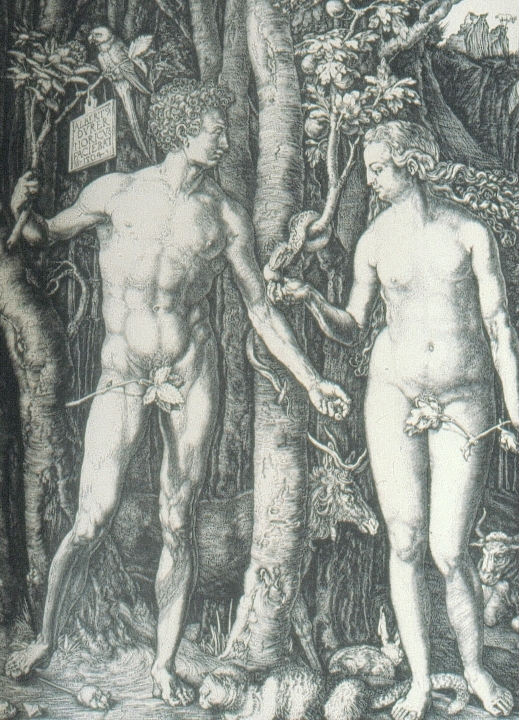
I enjoyed Panofsky’s discussion of the meaning of Dürer’s famous engraving, The Fall of Man. Dürer makes abundant use of animal and plant symbolism. For example, “the tense relation between Adam and Eve” is paralleled by a tense relation “between a mouse and a cat crouching to spring”13 (the mouse and cat are in the foreground, at Adam’s feet). A “wise and benevolent” parrot is contrasted with a diabolical serpent.
But the chief use of animal symbolism in The Fall of Man is to represent the “four humors” — sanguine, phlegmatic, choleric, and melancholic. Before The Fall, these four humors were perfectly balanced, or completely absent; only after The Fall are people characterized by a preponderance of one particular humor. Animals, however, have always been ruled by a particular humor; they have always existed in a fallen state.
| An educated observer of the sixteenth century... would have easily recognized the four species of animals in Dürer’s engraving as representatives of the “four humors” and their moral connotations, the elk denoting melancholic gloom, the rabbit sanguine sensuality, the cat choleric cruelty, and the ox phlegmatic sluggishness.14 |
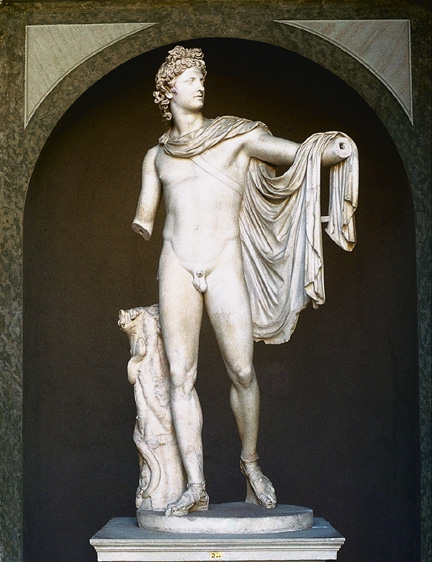
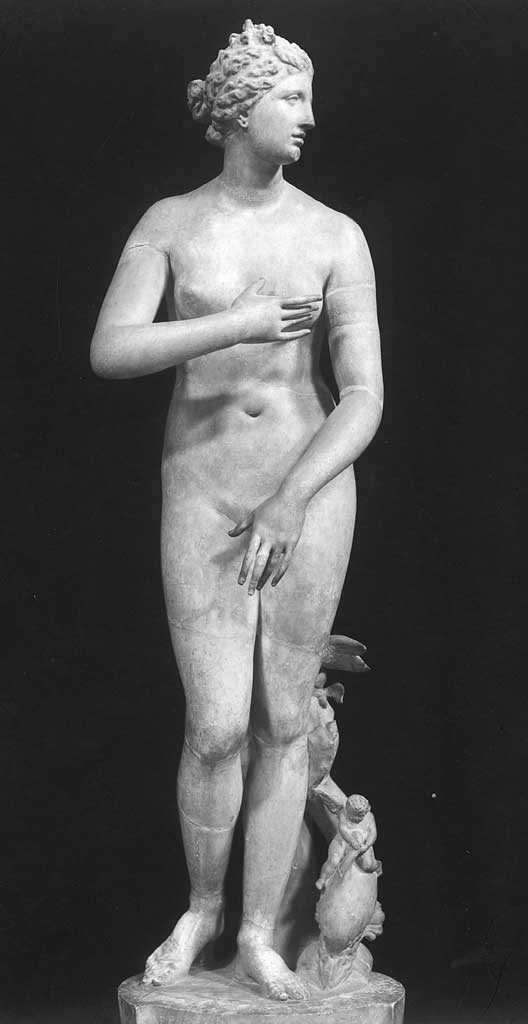
Panofsky notes that Dürer is trying to present models of human beauty, beauty as understood in the classical tradition. Greek sculptors began by depicting people erect and rigid — legs even, hips even, shoulders even. Later, however, Greek sculptors learned how to depict people standing at ease, with most of their weight on one leg; this pose is known as contrapposto (counterpoise). Panofsky says that Dürer was influenced by ancient examples of contrapposto such as the Apollo Belvedere and the Medici Venus. Dürer portrayed both Adam and Eve in a contrapposto attitude.
Panofsky says that Dürer’s Fall of Man was influenced by Pollaiuolo’s Battle of the Nudes, which we discussed in an earlier issue. Like Pollaiuolo’s nudes, Dürer’s nudes are set against a dark wood, to make them stand out. There is another parallel between the two engravings:
| Like Pollaiuolo, Dürer signed his engraving on an unusually large “cartellino” which hangs from a tree. It bears, for the first time in Dürer’s career, an inscription in Latin, and this inscription is worded so as to oppose to the pride of the Florentine the pride of the citizen of Nuremberg: as Pollaiuolo had written “OPVS ANTONII POLLAIOLI FLORENTTINI” so Dürer wrote “ALBERTVS DURER NORICVS FACIEBAT.” His satisfaction with his work is understandable; he had indeed contrived to “better the instruction.” While Pollaiuolo’s engraving, with all its emphasis on anatomical structure, yet gives the effect of an entangled Gothic ornament, Dürer’s Fall of Man has a quality which can be defined only as “statuesque.”15 |
Let’s compare the theory of four humors with Jung’s theory of four functions. Jung’s functions are feeling, thought, intuition and sensation. Feeling and thought are opposites; if one is rich in feeling, one will be poor in thought, and vice versa. Likewise, intuition and sensation are opposites. In the old theory of humors, however, there are no opposites (as far as I know); if one is rich in choler, for example, that doesn’t make one poor in another humor (though it may make one poor in all the other humors).
Jung doesn’t say that one function, one personality type, is the best, and another is the worst. In the theory of humors, however, the sanguine personality is considered the best, and the melancholic the worst (an unpleasant thought for us melancholics). Panofsky describes the sanguine type thus: “The sanguine seemed to surpass all other types in natural cheerfulness, sociability, generosity and talents of all description; even his faults, a certain weakness for wine, good food and love, were of the amiable and pardonable kind.”16
More than the other types, the melancholic was prone to insanity. “Thin and swarthy, the melancholic is ‘awkward, miserly, spiteful, greedy, malicious, cowardly, faithless, irreverent and drowsy.’ He is ‘surly, sad, forgetful, lazy and sluggish.’” The melancholic’s only redeeming feature is an inclination for solitary study.
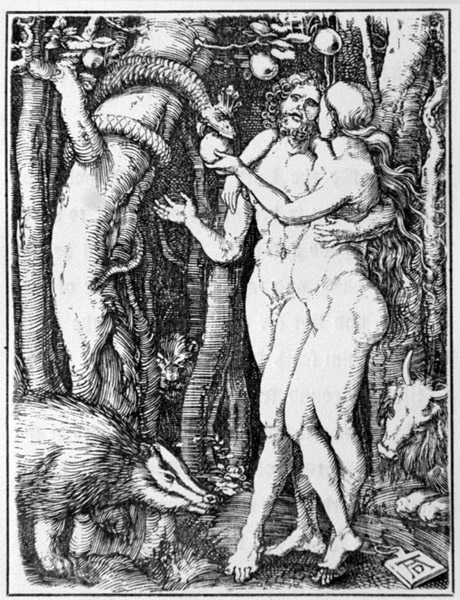
As mentioned before, it was believed that Adam and Eve were in a state of humor-less perfection before The Fall; Dürer’s Fall of Man reflects this belief. There was, however, another view, according to which Adam and Eve, before The Fall, were under the sway of the good humor, they were sanguine types. This view is reflected in Dürer’s second Fall of Man, a woodcut:
| Only three beasts are depicted, and they symbolize the non-sanguine temperaments, the lion standing for “choleric” wrath, the bison for “melancholic” gloom and inertia, and the particularly conspicuous badger, notorious for his laziness, for “phlegmatic” sloth. The “sanguine” temperament is represented by Adam and Eve themselves; they illustrate its most characteristic feature, the capacity and inclination for love.17 |
In this sonnet, the poet describes his descent into the depths of despond, then his spirits are lifted by the thought of his beloved son (Southampton). The melancholy mood is vintage Shakespeare, and may remind some readers of Hamlet. The sense of being an outcast, an outsider, is consistent with what we know of Oxford’s position in English society. The sense of being an outcast must have been especially strong at this moment, when his beloved son had just been arrested and thrown in the Tower for having participated in the Essex Rebellion.18 While it’s very easy for an Oxfordian to explain why the poet is “in disgrace”, it’s very difficult for a Stratfordian to explain this.
When in disgrace with fortune and men’s eyes,
I all alone beweep my outcast state,
And trouble deaf heaven with my bootless cries,
And look upon myself and curse my fate,
Wishing me like to one more rich in hope,
Featured like him, like him with friends possessed,
Desiring this man’s art and that man’s scope,
With what I most enjoy contented least;
Yet in these thoughts myself almost despising,
Haply I think on thee, and then my state,
Like to the lark at break of day arising
From sullen earth, sings hymns at heaven’s gate;
For thy sweet love remembered such wealth brings
That then I scorn to change my state with kings.
Harvey Mansfield’s new book, Manliness, has become the bestselling Straussian work since Allan Bloom’s Closing of the American Mind; Mansfield is becoming a celebrity. Like other Straussian works, Manliness takes a positive view of Plato and Aristotle, and a negative view of Nietzsche:
| No one, says Mansfield, understood the vices and virtues of manliness better than Aristotle and Plato. They gave it its due while “remaining wary of its dangers”.... The ancients well understood that too much — or too little — manliness is a bad thing. Too much is dangerous, but too little is fatal to a society’s prospects for greatness — or even for its survival.19 |
One is reminded of Aristotle’s theory that virtue is a mean between two extremes.
Mansfield says that modern philosophers don’t have enough respect for manliness:
| Modern philosophers err on the side of wariness and suspicion and, according to Mansfield, “the entire project of modernity can be understood as a project to keep manliness unemployed”.... Hobbes, for example, ignored the higher forms of heroic and philosophical manliness: He reduced it to a simple aggressive drive that leads to a “war of all against all.” It had to be broken — not accommodated — by handing over power and rights to an absolute sovereign. Hobbes placed self-preservation at the center of his theory. But, says Mansfield, manly men do not merely want to survive: They seek glory for themselves and their causes.... “Liberalism is unmanly in setting down self-preservation as the end of man, as do Hobbes and John Locke.”20 |
Perhaps Hobbes and Locke underrated manliness because their nation (England) wasn’t threatened by foreign powers; rather, it was threatened by internal division, civil war. They wanted their countrymen to be more peaceable, not more feisty. China, on the other hand, was often conquered by foreign powers, so the Chinese probably respected manliness, and wished that their nation had more of it.
In Nietzsche’s time, the danger seemed to be neither foreign invasion nor internal strife, but rather stagnation, mediocrity, the “last man”. Nietzsche fought stagnation by encouraging manliness. Mansfield criticizes Nietzsche for encouraging manliness that’s unrestrained and aimless:
| [Mansfield] sets up a dramatic contrast between the manly ideal favored by Plato and Aristotle and the unrestrained masculinity promoted by Nietzsche. Both Plato and Aristotle developed a conception of ethical manliness based on courage, tying manliness to protectiveness and reason.... By contrast, Nietzsche, a classicist by training, idealized the pre-Socratic Homeric age. He preferred the warrior to the philosopher, exalting Achilles over Socrates. He criticized Plato and Aristotle for putting reason above passion. For Nietzsche, says Mansfield, “Humanity is not to be found in reason but rather in the spark of life — the assertion of each man’s life by that man.” Nietzsche has burdened modernity with an exceptionally dangerous philosophy that Mansfield calls “manly nihilism.”21 |
Mansfield says that while Nietzsche is notorious for his pejorative remarks on women, he enjoys a certain popularity with feminists. In the 1970s, American feminists became fond of Nietzschean nihilism, as expressed by Simone de Beauvoir:
| She was the herald of the new nihilism. In Mansfield’s words, she was “Nietzsche in drag.” Far from being critical of Nietzsche’s hypermasculine fantasies, his “will to power,” and his rejection of the Judeo-Christian ethic — she embraced it all and urged women to emulate it. Beauvoir famously said, “One is not born, but becomes a woman.” She rejected the idea that there is anything like human nature or any other source of an authoritative moral order. When she said that women must seek “transcendence,” she meant that they should reject all the inducements of nature, society, and conventional morality. Beauvoir condemned marriage and family as a “tragedy” for women.22 |
The Straussian school is fond of reason — as Plato and Aristotle were; they’re uncomfortable with Nietzsche’s criticism of reason. Straussians think that the only alternative to reason is will, blind will, assertiveness. They don’t see the importance of spontaneity, non-rational spontaneity; they don’t realize that the unconscious is wiser than reason. They don’t understand Nietzsche, they don’t understand that Nietzsche tried to develop the whole person, not the partial person, not the rational person.
© L. James Hammond 2006
feedback
visit Phlit home page
make a donation via PayPal
| Footnotes | |
| 1. | “What Would Kierkegaard Do?” by Carlin Romano (The Chronicle Review, May 5, 2006) back |
| 2. | “Al-Qaeda faces an ideological crisis”, by Amr Hamzawy, Saturday, May 06, 2006 back |
| 3. | I discussed liberal movements in the Middle East in an earlier issue. back |
| 4. | “A Sage in Christendom: A personal tribute to Bernard Lewis,” Wall Street Journal, 5/1/06 back |
| 5. | The Atlantic Monthly, September 1990 back |
| 6. | Foreign Affairs, November/December 1998, “License to Kill: Usama bin Ladin’s Declaration of Jihad” back |
| 7. | see Wikipedia’s article on Neumann back |
| 8. | “Hammer & Tickle” by Ben Lewis, Prospect Magazine, May 2006. I found this article at Arts & Letters Daily. back |
| 9. | ibid back |
| 10. | ibid back |
| 11. | Untimely Essays, “Schopenhauer As Educator”, 1 back |
| 12. | ch. 5, p. 144 back |
| 13. | ch. 3, p. 84 back |
| 14. | ibid, p. 85 back |
| 15. | ibid, p. 87 back |
| 16. | ch. 5, p. 158 back |
| 17. | ibid, p. 144 back |
| 18. | For more on the identity of “Shakespeare”, the relationship between the poet and Southampton, the Essex Rebellion, etc., click here. back |
| 19. | “Being a Man: Harvey Mansfield ponders the male of the species,” by Christina Hoff Sommers, Weekly Standard, 4/10/2006 back |
| 20. | ibid back |
| 21. | ibid back |
| 22. | ibid back |